
My first breeding contract was two pages and mainly concerned with payment and registration. My current contract is eight pages and still missing things I wish I'd included. The evolution from the first to the current version was driven almost entirely by things that went wrong and clauses that would have prevented them or at least clarified what should happen when they did. This is what I've learned.
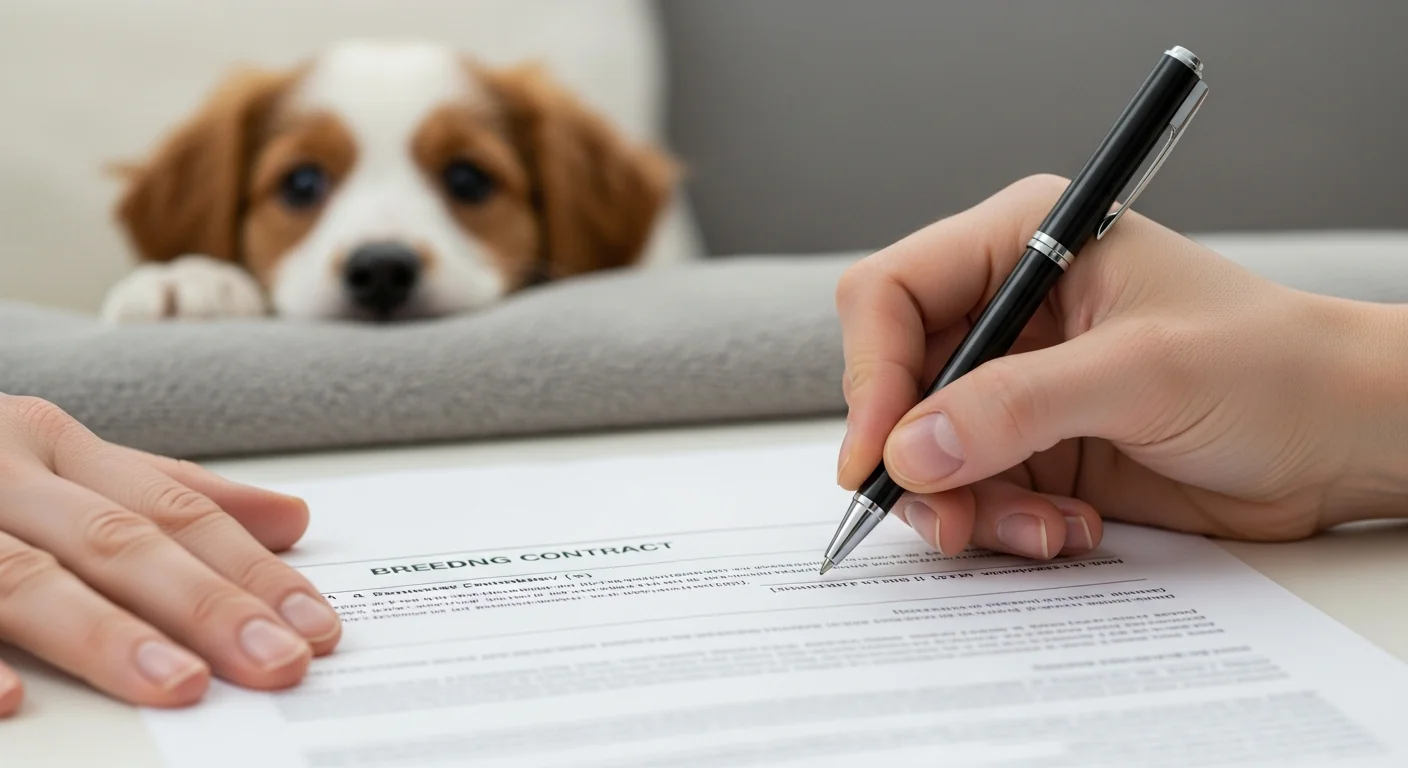
What a Breeding Contract Actually Does
A breeding contract serves multiple purposes simultaneously, and understanding all of them helps you draft one that works.
It sets expectations before commitment. A buyer who reads a thorough contract before signing understands what they’re committing to. If a clause surprises them, that’s a valuable conversation to have before placement rather than after. A buyer who objects to the return clause before signing will not honor it in practice, and it’s better to know that now.
It documents representations made. If I tell a buyer that a puppy’s parents have certain health clearances, that’s a representation. If it’s in writing, both parties know what was promised and what it meant.
It provides a framework for disputes. When something goes wrong — and something will go wrong, somewhere in twenty-five years of placing puppies — having a written framework for how to handle it reduces the emotion and increases the likelihood of a resolution that serves the dog.
It is not, importantly, a substitute for good judgment or good relationships. A contract cannot force a buyer to make good decisions. It can provide clarity and recourse, but it cannot prevent bad outcomes. The screening that happens before a buyer signs is more protective than any contract clause.
The Return Clause: Non-Negotiable
The most important clause in my contract has nothing to do with health or genetics. It’s the return clause: any dog I’ve bred must be returned to me rather than surrendered to a rescue, sold, given away, or relinquished to a shelter, for any reason, at any age.
This clause is the heart of ethical breeding. A dog I created is my responsibility for its entire life. If a family’s circumstances change, if they can no longer care for the dog, if they’re moving somewhere the dog can’t go, my door is open. Always.
What actually happens when a dog comes back is more complicated than a single clause can convey. But the clause establishes the principle, and the principle is that I am the safety net.
I’ve had people object to this clause. They feel it implies they might give up a dog, which they find offensive. I explain that the clause isn’t about their intentions — it’s about unpredictable circumstances. The family that has never imagined giving up a dog may face a situation in year seven that changes everything. This clause ensures that in that situation, the dog has somewhere to go that isn’t a rescue or a stranger.
The Health Clearance Documentation
I include in the contract a listing of every health clearance completed on both parents, with the date and certifying organization. Not a general statement that “parents are health tested.” The specific tests, the specific results, the specific dates.
This serves the buyer’s right to know exactly what they’re purchasing and holds me accountable to what I’ve represented. It also means that if a clearance expires or if I misrepresented the clearances, the evidence is in the contract.
I also include a section on what these clearances mean and don’t mean. A buyer who understands that an OFA Excellent hip score is a point in time evaluation, not a lifetime health guarantee, has realistic expectations. A buyer who reads “OFA Excellent” and believes it means their puppy will never develop hip problems is set up for a bad experience that damages the relationship.
The Clause That Saved a Relationship
In 2016, a buyer contacted me furious that their dog had developed a genetic eye condition I hadn't warned them about. The contract included a clause specifically noting that eye certifications represent a point-in-time assessment and that some progressive conditions manifest in adulthood. The buyer had signed that contract and received a copy. When we sat down with it, they acknowledged they'd read that clause and accepted it. The conversation was still hard, but the contract gave us a documented basis for it rather than a he-said-she-said disagreement.
Spay/Neuter Requirements
Most ethical breeders sell companion puppies with limited registration, meaning the puppies cannot have their offspring registered with the major kennel clubs. This is a way of maintaining some control over the genetics entering the show and breeding gene pool.
I include in my contract the timing of spay/neuter that I recommend. I do not typically require immediate early spay/neuter because the research on early desexing and long-term health outcomes, particularly for large breeds, is something I take seriously. My contract recommends waiting until hormonal maturity is complete, specifies the timeline I recommend, and requires notification if a buyer makes a different choice.
I’m transparent about this reasoning in the contract. Buyers who understand why I’m recommending something are more likely to follow the recommendation than buyers who see it as an arbitrary rule.
The Breeding Right Question
For dogs sold with full registration for breeding programs, the contract needs to address what obligations the buyer takes on as a breeder. This is where things get complicated.
My breeding right contracts require:
- Specific health clearances to be completed before any breeding
- Notification to me before any litter is produced
- Puppies from resulting litters to be sold with return clauses consistent with mine
- Offspring to carry the Snowpeak prefix in registration if using my lines as a foundation
This last point is a source of friction with some buyers who want full autonomy. I understand the impulse. But the genetics I’ve spent twenty-five years developing and the health tracking I’ve invested in are being passed on in those litters. Having some visibility into where they go matters to me, and I’m upfront about that from the beginning.
Co-ownership arrangements are a related topic that I’ve thought about extensively and moved away from in most circumstances, but for breeding program dogs, some form of ongoing relationship with the breeder makes sense, and the contract is the framework for defining it.
Dispute Resolution
My contract specifies that disputes will be resolved through mediation before either party pursues legal action. This isn’t foolproof, but it changes the dynamic significantly. Mediation requires both parties to engage in a structured conversation rather than immediately escalating. In my experience, most disputes that could become legal matters resolve in mediation because the underlying issue is miscommunication rather than genuine bad faith.
I also include a clause specifying that disputes are governed by Vermont law, which is where I’m based. This matters if a buyer is in a different state with different small claims or contract provisions.
What Not to Include
Contracts that try to control too much backfire. Clauses that specify where the dog can sleep, what food it must eat, or how many hours per week it must exercise create resentment without producing better outcomes. If I don’t trust a buyer enough to make reasonable daily care decisions, I shouldn’t place a puppy with them.
The contract should address the things that genuinely matter and can be agreed to specifically: health clearances, return provisions, breeding rights, dispute resolution. It should not attempt to micromanage a relationship that works best with mutual trust.
Have It Reviewed
A breeding contract is a legal document. If you're in the United States, have an attorney review it. The cost is modest and the protection is real. What you can enforce, what's unenforceable in your state, and how specific clauses will be read by a court are things a lawyer can tell you and you probably can't figure out on your own.
The Document is Not the Relationship
I say this at the end because it’s easy to lose sight of it while drafting contract language. The contract is documentation of a relationship, not the relationship itself.
The families I work with best are the ones I trust before they sign anything. The screening process, the conversations, the intuition I’ve developed about what a genuine commitment looks like — that’s the real protection for the dogs I breed. The contract is the safety net for when things go wrong despite everyone’s best intentions, and things will sometimes go wrong despite everyone’s best intentions.
Write a good contract. Then build the kind of relationships that mean you rarely have to invoke it.
Minimum Contract Elements
- Unconditional return clause — any dog, any time, any reason
- Specific health clearances for both parents, with dates
- Explanation of what clearances mean and don't mean
- Spay/neuter timing recommendation with reasoning
- Limited or full registration specification and conditions
- Dispute resolution mechanism before litigation