
I do not add complementary treatments to my dogs' routines on faith. I add them when I can name the problem, name the outcome I am measuring, and find a practitioner whose license and claims I can verify. Acupuncture and similar practices can sit alongside veterinary care, but only when someone is keeping records on both sides.
Why I Started Looking Outside the Clinic
My oldest bitch, Juniper, had a left hind lameness that came and went for eleven months. Radiographs were clean. The orthopedic vet found nothing surgical. I had spent close to two thousand dollars on diagnostics and had a dog who still skipped a stride on the stairs. That is the point where a breeder either accepts the answer or starts asking different questions.
I started asking different questions. Not because I distrust veterinarians, I do not, but because “nothing on the films” is not the same as “nothing wrong.” A friend who runs a search and rescue kennel mentioned she had used acupuncture for a dog with a similar pattern. I did not take her word for it. I went looking for what the evidence actually says, condition by condition, and I found this guide to acupuncture evidence useful precisely because it separates what has been measured from what has only been claimed.
That distinction matters to me more than it might to the average pet owner. I have made genetic mistakes in my breeding program that I am still paying for in paperwork and in difficult phone calls. I am not interested in another round of believing something because I want it to be true.
What Do I Check Before Trying Anything on a Dog?
Four things, in this order.
First, a diagnosis from a veterinarian who has actually examined the dog. Not a guess, not a breed predisposition, an exam. Complementary care is not a substitute for that exam, and any practitioner who suggests skipping it is a practitioner I will not use.
Second, a named condition. “General wellness” is not a condition. Chronic low back pain is a condition. Osteoarthritis of the knee is a condition. Allergic rhinitis is a condition. If I cannot name it, I cannot tell whether anything changed.
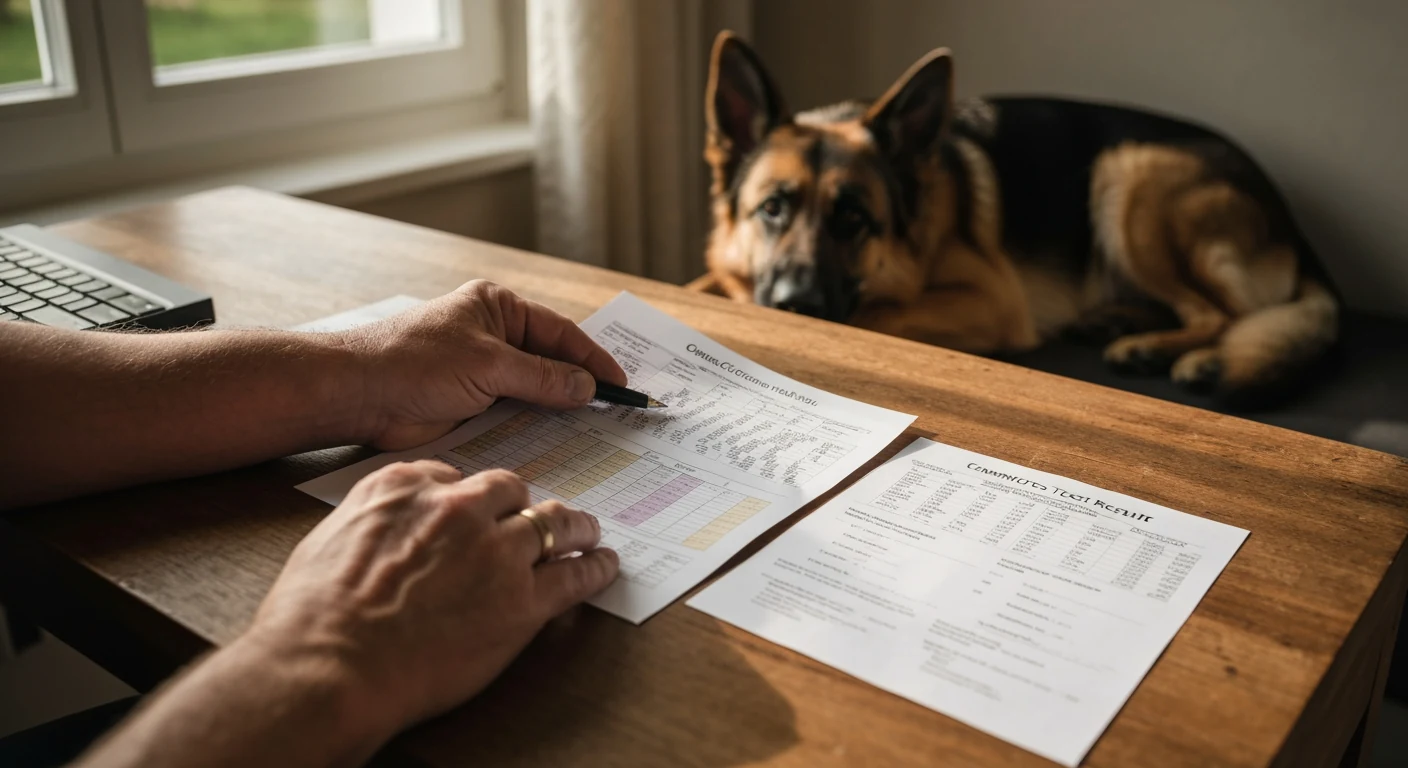
Third, a measurable outcome. For Juniper it was simple: how many times per week did she skip a stride on the stairs, counted on a whiteboard in the mudroom. For a dog with arthritis it might be how long he walks before he stops, or how long it takes him to rise after a nap. I write the baseline down before the first session, because memory is generous and I am not.
Fourth, the practitioner’s credentials. In the United States, acupuncture licensing is handled state by state, and the requirements differ. Some states license veterinarians to perform acupuncture with additional certification, some license human acupuncturists separately, and some have no specific license at all. I check the state board’s public license lookup before I book anything. If a practitioner cannot tell me which board licenses them, that is the end of the conversation.
How Do I Read the Evidence Without a Medical Degree?
Slowly, and with a bias toward sources that show their work.
What I look for is a plain statement of what was studied, in whom, for how long, and what was measured. I want to see the limits stated out loud. A page that says acupuncture helps with pain and stops there is not useful to me. A page that says the trials for chronic low back pain are mixed, that some are small, that blinding is difficult when the treatment involves needles, and that the measured effect is modest, is useful. That page tells me what I am actually buying.
The same standard applies to anything I put in a dog’s bowl. Herbal products and supplements interact with prescription drugs and with anesthesia. I have had a dog go under for a dental and had to list every single thing she was receiving, including a joint supplement I had been casual about. The anesthesiologist wanted to know. That conversation changed how I keep records.
I also want to know who wrote the page and whether they update it. A site that tracks its own recommendations over time is telling me something about how it treats its readers. A site that never revises anything is telling me something too.
What About the Risks and the Practical Side?
Needles should be single use. I ask. I have asked and been shown the sealed package, and I have also walked out of a clinic where the answer was vague. That is not a difficult call.
For human patients, Medicare coverage of acupuncture for chronic low back pain has changed in recent years, and the rules are specific enough that a patient needs to check their own plan rather than assume. I mention this because several of my puppy buyers are older adults managing their own pain while managing a young dog, and the two problems interact. A person who cannot walk comfortably cannot train a large breed puppy consistently, and a large breed puppy who is not trained consistently becomes a rehoming statistic.
There is also the question of what complementary care costs in time. A course of treatment is usually not one appointment. It is a series, and the dog has to tolerate the car, the table, and the handling. For a nervous dog, that stress can outweigh the benefit. I have stopped treatment for that reason more than once.
Does Any of This Belong in a Breeding Program?
No, and I want to be clear about that.
I do not select breeding dogs on the basis of how well they respond to acupuncture. I select on hips, elbows, temperament, and the records I can produce. Complementary care is what I use after a dog is already in my house and already has a problem. It does not enter the decision about whether that dog is bred.
What it does affect is how long a dog stays comfortable. Juniper is nine now. She still skips a stride occasionally. She also still runs the fence line when the neighbor’s tractor starts, which she did not do two years ago. I cannot prove the acupuncture did that. I can tell you what I counted, what changed, and what I paid. That is the whole of my claim.
What I Tell People Who Ask Me About It
Ask your veterinarian first, and ask them to say plainly whether they think this is worth trying for your dog’s specific problem. Get the diagnosis in writing. Write down your baseline before the first appointment. Check the license. Ask about single-use needles and about interactions with anything else your dog takes. Give it a defined trial period, eight weeks is what I use, and then look at your numbers and decide whether to continue.
If it works, keep the records. If it does not, stop, and do not feel obliged to keep paying for something because you started. I have stopped. I have also, once, kept going for three extra sessions past the point where I should have stopped, because I liked the practitioner and did not want to disappoint her. That was a mistake and it cost me about four hundred dollars and a wasted month.
The useful position, I think, is neither enthusiasm nor dismissal. It is a whiteboard in the mudroom, a license number you verified, and a willingness to write down the result even when the result is that nothing happened.